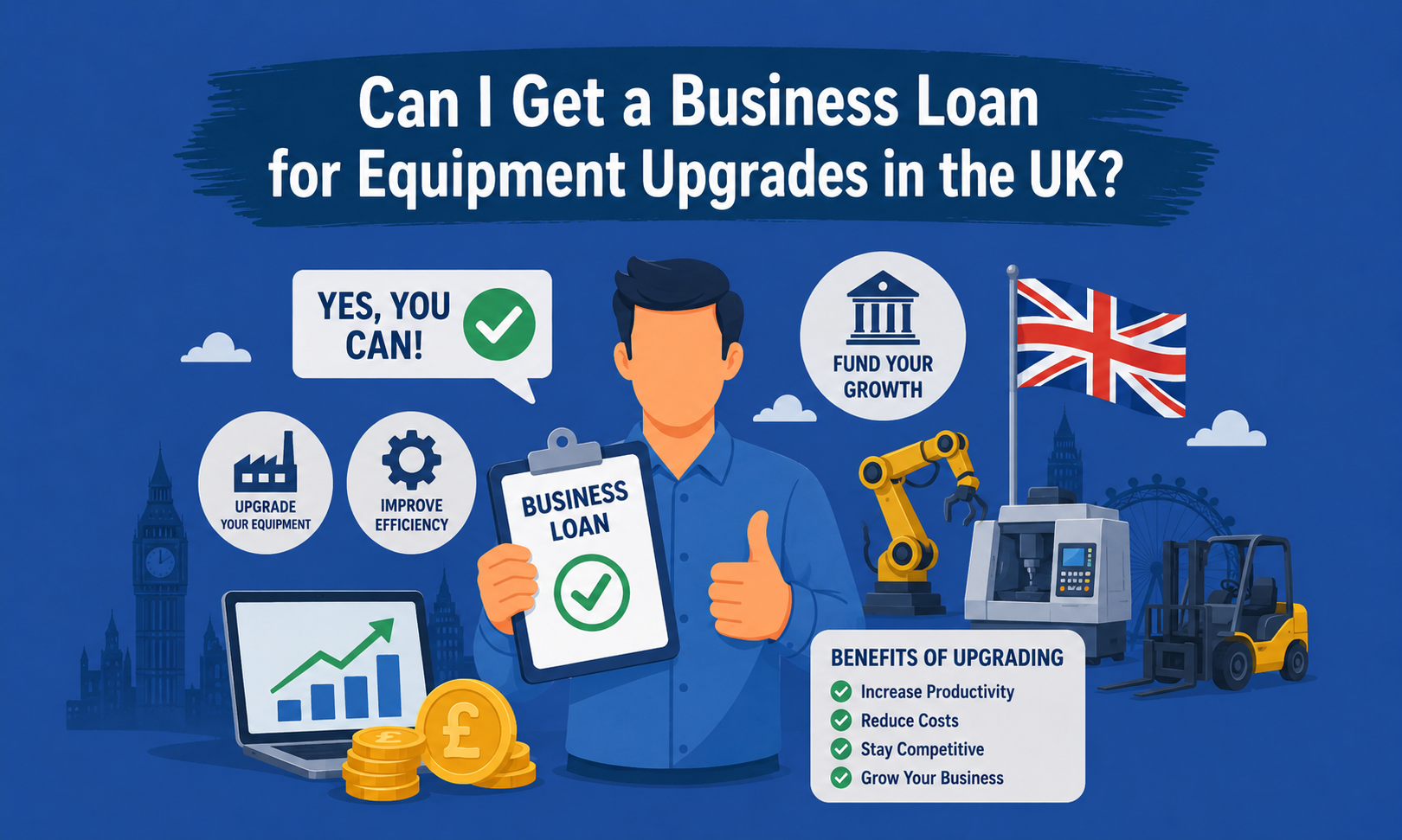
Yes, you can get a business loan for equipment upgrades in the UK; however, you must check your repayment capacity before applying for them, as the equipment you purchase serves the purpose of collateral.
Business loans are available from banks and direct lenders. However, the former follows the stringent criteria to sign off on them. Getting qualified for a business loan is a bit challenging. They are not as easily approved as small personal loans.
- In order to apply for a business loan, you must have a strong credit history.
- Whether or not your business has a separate legal entity, your personal credit rating will be checked.
- You will find it a bit difficult for you to receive approval for these loans if your business and personal credit ratings are not up to scratch.
- You must have been running a business for at least a year.
- You must have reached the breakeven point and been making profits.
- You should have at least 10% of the equipment you want to purchase as a down payment.
How do business loans work?
Business loans refer to a lump sum that you borrow to purchase equipment. The loan is paid back in fixed monthly instalments. The repayment period depends on multiple factors:
- Your credit history
- The value of the equipment
- Your profitability
Normally, the repayment length of business loans is up to five years. Monthly instalments remain the same throughout the loan period, and hence you can easily budget around payments.
It is crucial to pay off the debt on time as it will affect your business credit rating. Bear in mind that the equipment is considered collateral. In case you fail to discharge the debt, the equipment will be repossessed to cover the outstanding balance. It is recommended that you carefully analyse your credit rating.
How does hire purchase work?
Hire purchase is akin to business loans. The only difference is that business loans enable you to own the equipment from the date of purchase, although the lender has the upper hand.
If you consider hire purchase, you are required to pay fixed monthly instalments which go towards the purchase price. Once the final payment is made, the title of ownership is transferred to you. You will lose the equipment if you fail to keep up with instalments.
When you purchase equipment through hire purchase, you will be responsible for its maintenance.
How does equipment leasing work?
Equipment lease does not pass the title to you. It is similar to a rent agreement. Every month you pay a fixed sum of money towards its depreciation. Monthly payments remain unchanged throughout the lease period, and they are lower than those of business loans and hire purchase.
Once the lease contract expires, you are not entitled to retain the equipment. It is returned to your lessor.
Which financing option is the best?
There is no one-size-fits-all option. Business loans, hire purchase, and leasing are all popular financing methods when it comes to upgrading equipment. The method you choose depends on your cash flow strategy and how long you need to use the equipment.
- Business loans are ideal when you want to own the equipment right from the beginning, and you are completely certain that working capital will not be hindered.
- When working capital is a concern, you should consider hire purchase, provided you want to get the ownership. Both personal loans and hire purchase will help you spread the cost of equipment.
- Leasing is a good option only when you do not want to own it. You need it only for a short period of time, or you need to upgrade it frequently due to technological advancements.
Things to keep in mind
Keep in mind the following things before you consider your options for equipment financing:
- If you have some savings, make sure to use them. They will help reduce the loan amount, which means you will pay less interest.
- If you need a small amount of money to fund the purchase price, quick cash loans for small businesses can come in handy. These loans, however, charge high interest rates.
- If you are qualifying for hire purchase and business loans, make sure that your credit score is perfect. Lenders may want you to give a personal guarantee when your business has a separate legal entity. It means you will have to settle the debt on your own when your business fails.
- A bad credit loan from a direct lender is also available, but they charge high interest rates.
- Try arranging a larger down payment to avail yourself of lower interest rates.
The bottom line
It is not difficult to get a business loan for equipment upgrades, but interest rates might not always be lower. Multiple factors influence the total cost of the purchase. Make sure to carefully evaluate your overall credit profile.
FAQs
- Are equipment loans the same as business loans?
Yes, equipment loans are the same as business loans. When you take out a business loan for the purchase of equipment, they are called an equipment loan.
- What documents do you need to apply for equipment financing?
You need to submit the following documents to apply for business loans:
- A copy of the bank statement
- A statement of profit and loss account
- An income tax return for the previous year
- A cash flow statement
- Should you buy equipment outright or spread the cost?
If you have enough money to pay for it, buying outright might sound like a good option, but make sure that your business’s working capital does not decline. Otherwise, consider spreading the cost.
- Do you need collateral?
No, equipment financing does not need collateral because the equipment you purchase itself serves the purpose of collateral.
- Is equipment financing considered debt?
Yes, it works the same way as any other loan. Late payments and defaults will ruin your credit score.

Hi everyone, I am Lukas Thomas. I am a professional writer and author with having specialisation in the UK financial sector. I have more than 13 years of experience as the financial writer and hope it will continue longer. I have done my post-graduation in Masters of Business Administration (MBA) in Finance. Currently, I am performing my responsibility as a Senior Loan Expert in CashLoans2go, which is the fastest-growing online direct lending company. My job is to prepare borrower-friendly loan deals as per the company’s guidelines. I also write research-based blogs for the company’s official website. You can read them and gain knowledge on any loan product.